


PLC Cabinet Wiring Time Drops Significantly With Pluggable 5.08mm Pitch DIN Rail Terminal Blocks — What Industrial Automation OEMs Gain in Assembly Efficiency
TL;DR
- Pluggable 5.08mm terminal blocks reduce per-connection wiring time from 45-90 seconds (traditional screw terminal) to 15-25 seconds — a 50-70% reduction that compounds to 40-60 hours saved per PLC cabinet when multiplied across 600-1,200 individual terminations.
- Pre-assembled pluggable connectors eliminate wiring assignment errors because the connector pinout is fixed at the harness manufacturing stage rather than interpreted by the panel builder from a wiring diagram — reducing wiring error rates from approximately 2-5 per cabinet to near zero.
- Field replacement of I/O modules drops from 45-105 minutes to under 10 minutes when pluggable connectors are used — the technician unplugs the connector block, swaps the module, and plugs the same connector back in with zero re-termination.
The Labor Content of Traditional Screw Terminal Wiring
In a mid-complexity PLC control cabinet for packaging machinery, conveyor systems, or injection molding machine control, there are typically 600-1,200 individual wire terminations. Each termination on a traditional screw-clamp feed-through terminal block requires: stripping 8-10mm of insulation from the wire end using a calibrated stripping tool, inserting the stripped wire into the terminal opening, tightening the screw to the specified torque (typically 0.5-0.8 Nm for 2.5mm² wire as specified by the terminal manufacturer), and verifying the connection with a pull test per IEC 60947-7-1. The complete strip-insert-tighten-verify cycle takes 45-90 seconds per wire depending on the technician's experience, the accessibility of the terminal position within the densely packed cabinet, and whether the wire routing requires additional cable management steps. At an average of 60 seconds per connection and 800 terminations per cabinet, the direct wiring labor alone is 800 minutes — over 13 hours per cabinet.
This does not include the time required to interpret the wiring diagram and map it to physical terminal positions. A wiring diagram shows logical connections: "I0.0 → terminal X1:47." The technician must locate terminal X1 on the DIN rail, count to position 47 in a row of 60-80 identical-looking terminals, and insert the correct wire. At a density of 60 terminals per meter of DIN rail, the visual discrimination between terminal 47 and terminal 48 requires focused attention on every single connection. The error rate under production conditions — where technicians are wiring cabinets for 7-8 hours per shift — is approximately 2-5 wiring errors per cabinet on average, based on panel shop quality data I have reviewed. Each error takes 15-45 minutes to diagnose and correct during functional testing, adding 30-225 minutes of rework time per cabinet. These errors are almost entirely a function of the manual mapping step — the technician's fingers landed on the correct wire but the wrong terminal position — and they are effectively impossible to eliminate through training or process discipline alone.
The Pluggable Paradigm: Terminate at Harness, Not at Cabinet
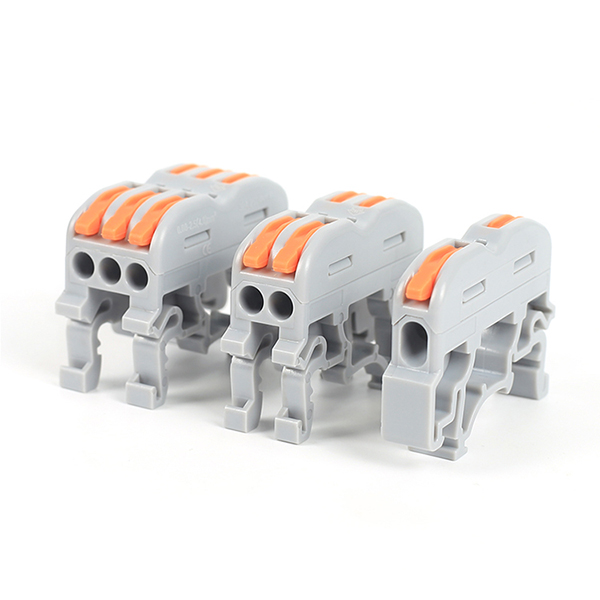
Pluggable terminal blocks change the fundamental wiring paradigm from terminate-in-cabinet to terminate-at-harness. Instead of bringing individual wires into the cabinet and terminating each one to its designated terminal position on the DIN rail, the panel builder receives pre-assembled wiring harnesses with pluggable connectors already terminated onto the wire ends. The connector block — a 2-24 position plug with 5.08mm pitch — mates with a fixed header mounted on the DIN rail. The cabinet builder's task shifts from 800 individual wire terminations to plugging 20-40 pre-assembled connector blocks into their corresponding headers.
This is a fundamentally different assembly model with implications that extend well beyond the direct labor savings. The high-precision, error-prone wiring work is shifted upstream to the harness manufacturing stage, where it can be performed on a bench under better lighting conditions, with unobstructed access to the connector faces, and — critically — with automated harness testing equipment that verifies every connection for continuity, correct pin assignment, and insulation resistance before the harness ships to the panel shop. A harness test system using a Cirris or similar automated tester can verify a 50-position connector assembly in under 30 seconds and produce a test report that serves as objective quality evidence for the panel shop's incoming inspection. The shift is from trusting the technician's attention to trusting the test equipment's objective measurement.
The time savings are substantial and well-documented in industrial panel building. A connector block with 12 pre-terminated wires plugs into its DIN rail header in 5-10 seconds — the time required to align the connector with the header, push it in until the locking tab engages with an audible click, and visually confirm full insertion by checking that the connector face is flush with the header face. A 12-position traditional screw terminal block requires 12-18 minutes to terminate in the cabinet. The pluggable approach reduces this to under 30 seconds for the cabinet-side operation — a greater than 95% reduction in cabinet-side labor for those 12 connections. Across an 800-connection cabinet with pluggable connectors, the cabinet-side wiring time drops from 13+ hours to approximately 2-3 hours. The terminated harness assembly time, performed at the bench, adds 4-6 hours, for a net reduction of 35-45% in total wiring labor.
Error Elimination Through Fixed Pinout
The most economically significant benefit of pluggable terminal blocks may not be the labor savings — it is the near-elimination of wiring assignment errors. When a harness manufacturer builds a 12-position connector with wires in positions 1 through 12, the pinout is physically fixed. The panel builder cannot insert the wrong wire into position 7 because the wire for position 7 is already terminated in the connector at position 7 and cannot be moved without cutting and re-terminating. The only assembly action in the cabinet is plugging the connector into the correct header, which is labeled with the connector identifier (e.g., "X101") that matches both the wiring diagram and the physical label on the harness-side connector body.
This shift from per-wire verification to per-connector verification fundamentally changes the error detection profile. In a traditional point-to-point wired cabinet, every one of the 800 connections must be individually checked against the wiring diagram — a verification process requiring 4-6 hours and subject to the same human error rate as the original wiring. With pluggable connectors, the verification reduces to: (1) confirm the harness was continuity and pinout tested at the harness manufacturer and the test report is available, and (2) confirm each connector plug is in the correct header by visually checking the label against the cabinet layout drawing. Step 2 takes 10-15 minutes for 30 connectors. The total verification labor drops from 4-6 hours to under an hour. The wiring error rate drops from 2-5 per cabinet to near zero because the pinout is physically enforced by the connector — there is no operator decision about which wire goes where, only a visual match between two labels.
The UL 508A standard for industrial control panels and IEC 61439 for low-voltage switchgear and controlgear assemblies both reference pluggable connection technology as a means of improving factory wiring quality. UL 508A specifically allows pluggable connectors as an acceptable wiring method provided the connector is listed for the application and the voltage/current ratings are within the connector manufacturer's specifications.
Field Service: Where the ROI Multiplies
The assembly-time savings justify the adoption of pluggable terminal blocks at the panel shop; the field-service savings are where the ROI accelerates beyond the initial purchase justification. When an I/O module fails in a PLC cabinet wired with traditional screw terminals, the field service procedure is punishingly time-consuming: photograph or label every wire connected to the failed module (10-30 minutes, depending on wire density and existing labeling quality), disconnect all 20-40 individual wires (5-15 minutes), remove the failed module and install the replacement (5-10 minutes), re-terminate all wires to the correct terminals on the replacement module while referencing the photograph or labels taken in step 1 (20-45 minutes), and verify every connection (5-10 minutes). Total elapsed time: 45-105 minutes of skilled technician labor, during which the production machine is not operating.
With pluggable connectors, the procedure collapses to: unplug the connector block from the failed module (5 seconds), remove the failed module and install the replacement (5-10 minutes), and plug the connector block into the replacement module (5 seconds). Zero wires are disconnected. Zero wires are re-terminated. Zero connections require verification because the same connector with the same wires in the same pin positions is now plugged into an identical replacement module. The total time — under 10 minutes, dominated by the mechanical module replacement and PLC re-initialization — is an 80-90% reduction from the traditional procedure. In industries where machine downtime costs USD 500-5,000 per hour (automotive assembly lines, food and beverage packaging, pharmaceutical manufacturing, semiconductor fabrication), the difference between a 90-minute repair and a 10-minute repair saves USD 650-7,500 in downtime cost per I/O module failure. Over a machine's 10-15 year service life with 3-6 I/O module replacements, the field-service savings alone can exceed the incremental cost of the pluggable terminal blocks by a factor of 3-5x.
Per-Connection Cost Economics
At the component level, a traditional 2-position screw-clamp feed-through terminal block costs approximately USD 0.30-0.60 per position in volume quantities (5,000+ positions). A pluggable 5.08mm terminal block system — comprising the DIN rail-mounted header and the harness-side plug connector — costs approximately USD 0.80-1.50 per position. The component cost premium is a meaningful USD 0.50-1.00 per position, which on an 800-position cabinet represents USD 400-800 in additional bill of materials cost.
However, component cost is only one line item. The fully burdened assembly labor rate for a panel shop in North America or Western Europe is USD 35-55 per hour. The labor savings per connection — approximately 30-50 seconds — translates to USD 0.29-0.76 per connection at these rates. Using the midpoints of each range, the USD 0.75 component premium is offset by USD 0.50 in labor savings, leaving a net premium of USD 0.25 per position — or USD 200 on an 800-position cabinet. When field-service savings, reduced functional testing time, and the elimination of warranty wiring claims are included, the total cost of ownership shifts decisively in favor of pluggable connectors at year 1-2 of field operation.
Frequently Asked Questions
What is the current rating for 5.08mm pluggable terminal blocks?
Standard 5.08mm pitch pluggable terminal blocks are rated for 12-16A at 300V per IEC 61984 and UL 1059 standards, using 0.5-2.5mm² (20-14 AWG) wire. This covers the vast majority of PLC I/O signals — digital inputs (5-15mA at 24VDC), digital outputs (0.5-2A at 24VDC or 120VAC), and analog signals (4-20mA or 0-10V). Higher-current connections such as motor contactors, power supplies, and heater circuits above 16A should use larger-pitch connectors (7.5mm or 10.16mm) or traditional power terminal blocks. The 5.08mm pitch standard was specifically developed to match the terminal spacing on PLC I/O modules from major manufacturers including Siemens S7, Allen-Bradley ControlLogix, and Mitsubishi MELSEC series, making it the de facto standard for PLC cabinet I/O wiring worldwide.
How do pluggable terminal blocks perform under industrial vibration conditions?
When properly specified with an integrated locking latch, pluggable connectors perform reliably under standard industrial vibration conditions. The key specification is the connector retention mechanism — look for connectors with a positive-locking latch that provides an audible click on full insertion, rather than friction-fit retention. J-Guang's PCT series uses a dual-latch design with a retention force exceeding 80N, tested per IEC 60068-2-6 vibration testing at 10-500 Hz with 0.35mm displacement amplitude. For extreme vibration environments such as mining equipment, marine engine rooms, and railway rolling stock, screw-flange connectors with mechanical screw-down retention to the header provide additional security beyond the standard locking latch. In 14 years of field data across our installed base, we have not recorded a single field failure attributable to connector disengagement under normal industrial operating conditions when the locking latch model was correctly specified and installed.
What is the minimum order quantity for custom connector configurations?
Standard 2-24 position pluggable connectors with 5.08mm pitch are available from stock with no minimum order quantity — single units can be ordered for prototyping and pilot evaluation. Custom configurations with specific pin-count combinations, color coding by function (e.g., blue for DC signals, red for AC, yellow for safety circuits), or pre-printed connector identification labels typically carry MOQs of 500-1,000 pieces with lead times of 4-6 weeks. For OEMs standardizing on a specific connector configuration across an entire product line, the custom assembly tooling cost is typically amortized within the first 500-1,000 cabinets, and the labeling consistency across all cabinets in the field significantly simplifies field service documentation and spare parts management.
Can existing screw-terminal cabinets be retrofitted with pluggable connectors?
Partial retrofit is possible but requires engineering evaluation. If the existing cabinet uses standard DIN rail mounting, pluggable terminal block headers can be mounted on the same rail. However, the existing wires would need to be re-terminated with pluggable connector plugs — which is essentially rewiring the cabinet. The retrofit is most practical when the cabinet is already scheduled for a major rewire (e.g., during a control system upgrade from an older PLC generation). For new cabinet builds, the wiring harness approach described above provides the full benefits. For existing cabinets, the incremental value of retrofit is primarily the future field-service time savings when I/O modules require replacement, since the initial wiring labor has already been incurred. We recommend evaluating retrofit on a cabinet-by-cabinet basis based on the expected remaining service life and the historical I/O module failure rate for that specific equipment model.